Roman Bridges That Still Stand: A Timeline of Engineering Survival
A bridge is a bet placed against a river. Roman engineers placed theirs two thousand years ago, and a surprising number of those bets are still being collected. The Pons Fabricius in Rome has carried foot traffic since 62 BC. The Ponte di Tiberio in Rimini still crosses the Marecchia on five arches finished in AD 21. Walk across either and you are standing on somebody's confident arithmetic.
Most Roman bridges are gone, of course. Floods took them, wars took them, and later centuries recycled their stone. The survivors are the interesting ones, because they were not necessarily the most beautiful or the most ambitious. They were the ones whose materials, foundations and geometry happened to agree with their river.
The First Survivors: Second and First Centuries BC
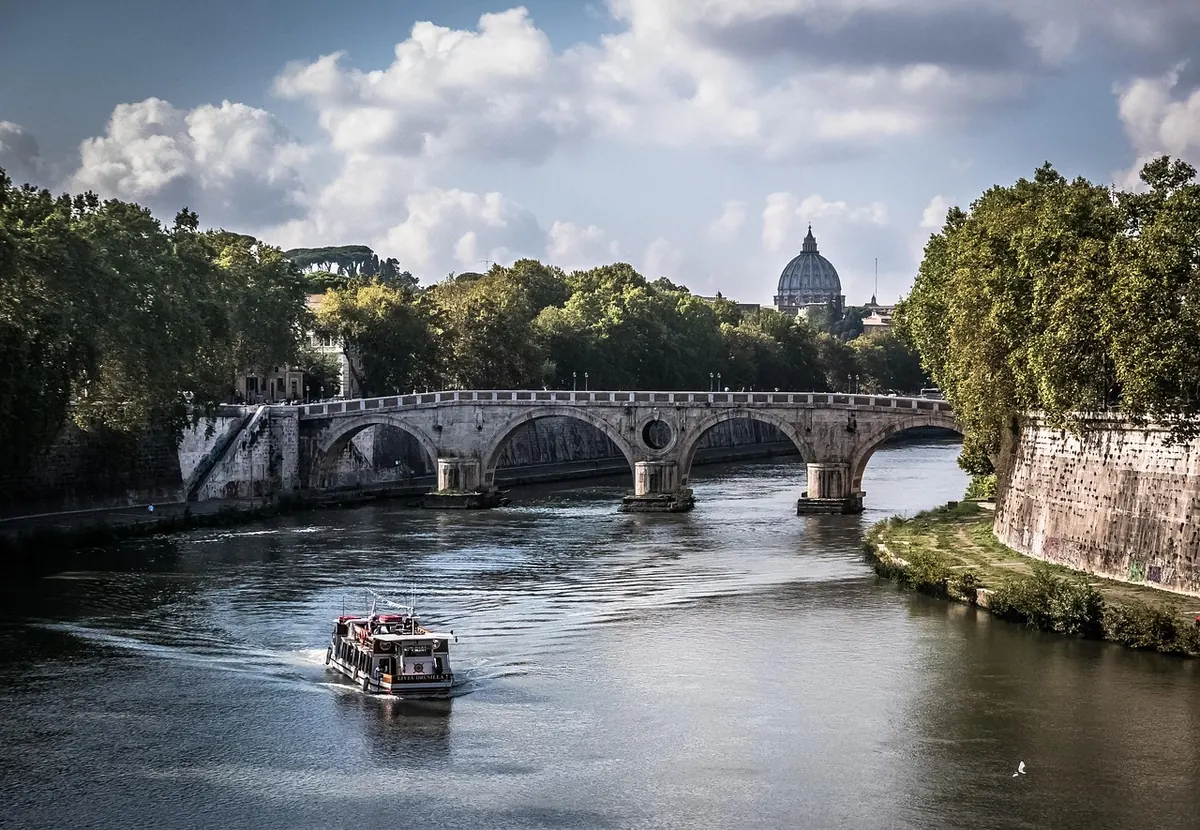
The oldest Roman bridge still standing in Rome is the Pons Fabricius, built by Lucius Fabricius, the city's road commissioner, in 62 BC. It links the Tiber Island to the Campus Martius on two arches, and apart from a restoration in 21 BC it has kept its original structure. Look closely at the facing: travertine blocks over a core of tuff and rubble set in lime mortar. The travertine takes the wear; the core takes the load. It is a two-material solution that Roman builders used again and again.
Nearby, the Pons Aemilius has fared worse. Voted into existence in 179 BC and rebuilt in 142 BC, it lost arches to floods over the centuries, and the last orphaned span, known locally as the Ponte Rotto, was left stranded in the river in the late nineteenth century. It is a useful corrective to any romantic idea that Roman bridges were simply immortal. They were well built. Rivers are patient.
North of Rome, the Ponte Milvio carries the Via Flaminia over the Tiber on a site used since the third century BC, though the present structure is a palimpsest of rebuilds. The lesson from this earliest layer of survivors is modest but real: stone-faced arches on wide piers, built where the river is comparatively well behaved, will outlast almost anything.
Augustus and the Provinces: Standardisation Pays
With the Empire came budgets and engineers who travelled. Bridge design became something close to a standard product, and the results are scattered from southern France to Spain.
- Pont Julien, Provence (3 BC): three arches on the Via Domitia, built of limestone blocks cut with close joints. It carried traffic until 2005, when a bypass finally took the load off.
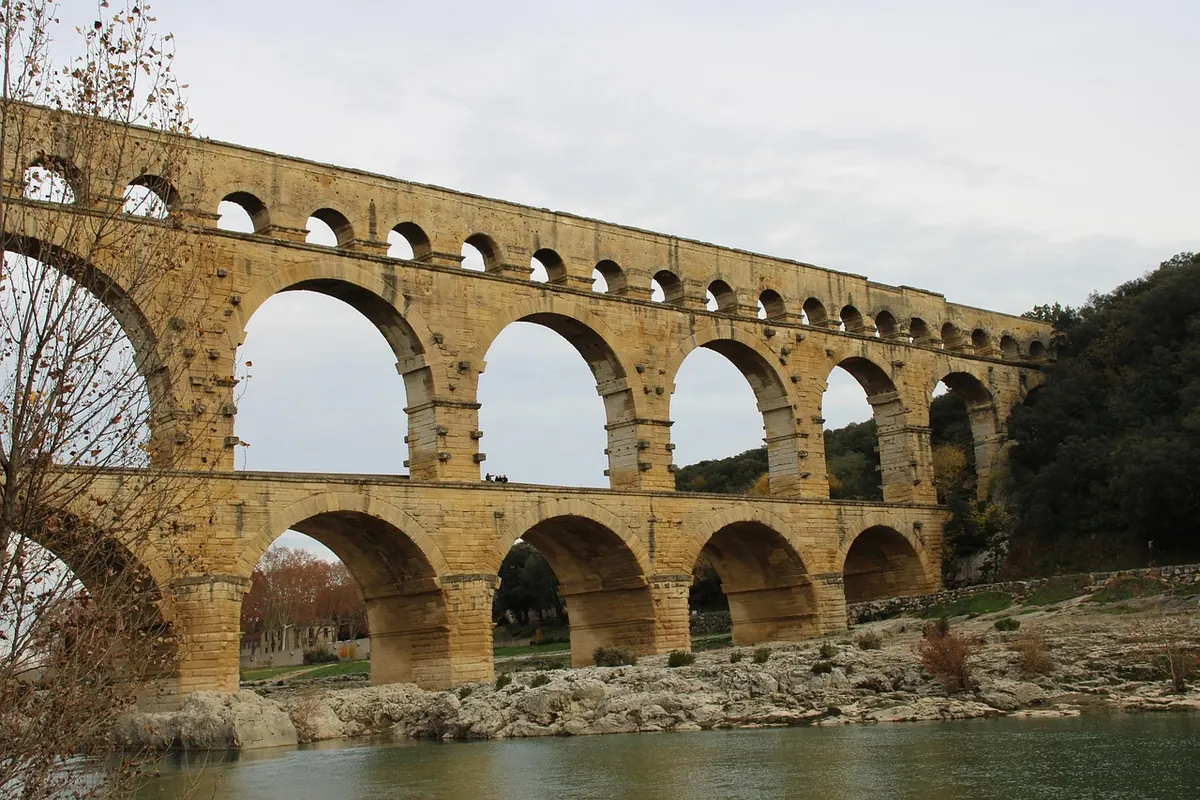
- Pont du Gard (mid first century AD): strictly an aqueduct bridge, not a road bridge, but the finest surviving demonstration of Roman arch stacking, with three tiers of arches carrying water 49 metres above the Gardon.
- Ponte di Tiberio, Rimini (AD 14–21): five shallow arches in Istrian stone, with the wide, streamlined piers that let floodwater pass without tearing at the foundations.
- Puente Romano, Mérida (c. 25 BC): granite, originally some sixty arches, with cutwaters that split the current rather than fight it.
Augustan bridges tend to share proportions: semicircular arches, pier thickness roughly a third to a half of the span, and a roadway that rises slightly toward the centre. Those proportions are not decoration. They are a calculated trade between span and stability, and they held.
Trajan and Hadrian: The Outer Limit of the Span
The semicircular arch has a hard ceiling. The wider you push the span, the higher the crown rises and the harder the abutments must work. Roman builders knew this, and mostly accepted it, which is why their piers are so generously fat compared with a modern bridge.
The Alcántara bridge over the Tagus, completed around AD 106 under Trajan, shows what happens when the site demands the maximum. Six granite arches, the largest spanning roughly 28 metres, with the roadway some 48 metres above the water. The blocks are cut and fitted so closely that mortar plays a secondary role; the structure works by compression and careful jointing. It has been damaged and repaired, but it is still there, and it still takes pedestrians.
Hadrian's Pons Aelius, now the Ponte Sant'Angelo in Rome, was finished in AD 134 in travertine and originally had seven arches, of which five remain. Farther north, the Ponte d'Augusto at Narni, built in AD 27, kept one of the tallest Roman arches anywhere until it was largely lost to floods and time; the surviving fragment is a study in how much height a single arch can carry.
What the Materials Actually Tell You
Roman longevity is often attributed to "Roman concrete", and that is only half the story. Many of the best-surviving bridges used very little mortar in their arches at all.
Stone choice was local and deliberate
Travertine, tuff, limestone, granite, basalt and Istrian stone each behave differently. Travertine is porous and slightly self-healing in wet conditions. Granite is nearly inert but hard to cut. Limestone dissolves slowly in polluted air and fast in acidic water. Roman builders quarried as close to the site as they could and then matched the block size to the stone's strength.
Mortar was a tool, not a religion
Where the Romans did use mortar, they used lime, often mixed with volcanic pozzolana, which sets hard even underwater. That mattered for foundations, where a hydraulic mortar could be cast inside a timber cofferdam and left to cure. In the arch ring itself, thin joints, tight fits, iron clamps and lead seals often did the work instead.
Foundations decided everything
Most Roman bridge failures begin below the waterline. The survivors sit on bedrock, on timber piles driven into stable gravel, or on wide spread footings protected by cutwaters. When you see a triangular or rounded prow on a pier, you are looking at flood defence in masonry form.
Details That Bought Centuries
If you want to understand why one bridge lasted and its neighbour did not, stop looking at the whole thing and start looking at the parts. The same handful of decisions comes up again and again.
- Wide piers, widely spaced. Generous piers resist scour and impact; the cost is fewer, smaller openings, which is exactly why Roman bridges look heavy.
- Cutwaters on both faces. They deflect debris and reduce the vortex that scours a riverbed around a pier.
- Deep, oversized foundations. Roman engineers routinely built footings far larger than the load required, which bought them tolerance for later scour.
- A stable arch ring. Voussoirs of even size, laid radially, with a proper keystone, keep the line of thrust inside the masonry.
- Drainage and a light fill. Water trapped inside a bridge is a slow destroyer; Roman roadways usually shed it.
- Siting that respected the river. A crossing placed where the channel is narrow and the banks are rock will always outlive one placed on an eroding floodplain.
Reading a Roman Bridge on Site
Next time you are near one, give it fifteen minutes rather than a photograph. Stand upstream and look at the piers: are the cutwaters pointed or rounded, and are they original or later additions? Walk to the springing of an arch and check the joint width, then look for the tell-tale holes of vanished iron clamps. Find where the modern repairs begin, usually a band of different stone or a concrete saddle, and ask what failed there first. Check the abutments, since that is where most old bridges actually give way. And look at the river's own geometry, because a bridge is a record of how a channel has behaved for two thousand years.
The survivors are not a random sample. They are the ones whose stone suited the water, whose foundations reached something solid, and whose proportions left a margin for error that nobody has yet exhausted.
Photo: EmoteBot / Pixabay